Biodegradable & Compostable Garbage Bags: Science, Benefits, and Everyday Uses
By Harshita Mudgal
4 mins
2025-12-05
0
0
Copy Link
📑 Table of Contents
- Overview
- What Are Biodegradable & Compostable Bags?
- The Science Behind Biodegradation & Composting
- Biodegradable vs Compostable vs Regular Plastic: Key Differences
- What Are D-Cut Bags? (And Why Many Retailers Prefer Them)
- Top Benefits of Using Biodegradable & Compostable Bags
- Best Use Cases (Home, Retail, Business & More)
- How to Choose the Right Bags for Your Needs
- Final Thoughts
- FAQs
Overview
If there's one thing that quietly piles up without us noticing — it's plastic waste.
From grocery bags to garbage liners, we use them daily, toss them out, and they linger in landfills for hundreds of years.
But now, alternatives like biodegradable garbage bags and compostable bags are available which break down faster and reduce the pressure on our planet.
These aren't just "trendy green swaps."
They're backed by science, used worldwide, and increasingly recommended by environmental bodies especially for daily household and retail use.
What Are Biodegradable & Compostable Bags?
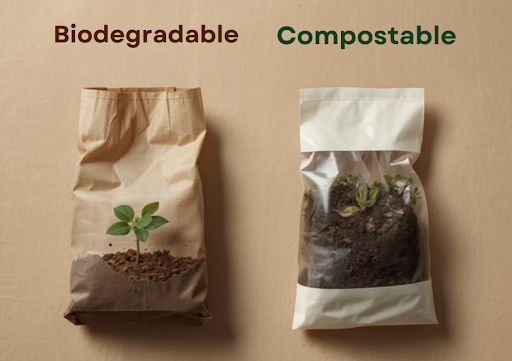
Biodegradable Bags
Biodegradable bags are designed to break down naturally with the help of microorganisms like bacteria and fungi. They don't stick around for decades like regular plastic.
They're typically made from:
- Starch blends
- Plant-based polymers
- Bio-plastics like PLA
- Even some petroleum plastics with additives (not the eco-friendliest option)
The speed and quality of biodegradation depend on the material and the conditions they're exposed to. Some break down quickly, others take longer and not all disappear completely.
Compostable Bags
Compostable bags take eco-friendliness to the next level. These bags break down completely into water, CO₂, and nutrient-rich compost, leaving behind zero toxic residue.
To ensure this clean breakdown, they must meet global standards like:
- EN 13432 (Europe)
- ASTM D6400 (USA)
- IS/ISO 17088 (India)
They're made from nature-friendly materials such as:
- Corn starch
- Potato starch
- PLA (Polylactic Acid)
- PBAT blends certified for compostability
And the best part?
In composting conditions, they usually disappear within 3–6 months , making them perfect for kitchen waste, food scraps, and sustainable packaging.
🌱 Think of it in this way:
All compostable bags are biodegradable but compostable bags are the only ones guaranteed to return to the earth cleanly.
The Science Behind Biodegradation & Composting
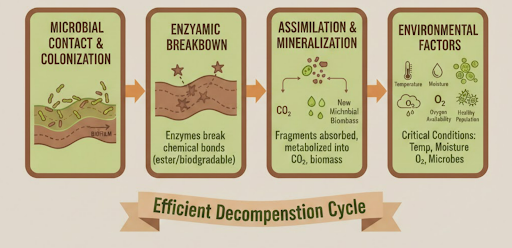
Biodegradation is a natural, biological process powered by microorganisms, bacteria, fungi, and other tiny lifeforms that "eat away" at biodegradable materials. Here's how it happens step-by-step:
- Microbial contact & colonization — Microbes first land on the surface of the material and over time, they group together to form a thin layer called a biofilm, which helps them cling to and penetrate the material.
- Enzymatic breakdown — These microbes release specialized enzymes that break the chemical bonds in the material, often ester or other "biodegradable" bonds that convert complex polymers into smaller fragments.
- Assimilation & mineralization — Once broken down, the smaller fragments (oligomers , monomers) are absorbed by microbes. Inside the microbes, these fragments are metabolized into simpler substances such as carbon dioxide (CO₂), water, and new microbial biomass (living matter).
- Environmental factors matter — For biodegradation to be efficient, conditions like temperature, moisture, oxygen availability, and the presence of a healthy microbial population are critical.
Composting is essentially "biodegradation on fast-forward." Under the right composting conditions typically found in industrial or well-managed compost setups, biodegradable materials degrade much faster and more completely. Here's what composting does differently:
Composting involves elevated temperature (typically in the range of 50–70 °C), high humidity, adequate oxygen, and a rich microbial environment. These factors collectively speed up the chain-breaking, assimilation, and mineralization processes.
In such ideal conditions, certified compostable bags (often made from materials like PLA, PBAT, or plant-based polymers) can fully disintegrate, not just fragment, often within 90–180 days, leaving behind only water, CO₂, and compostable organic matter.
Why this matters:
Biodegradable bags may degrade but only under favorable conditions. If they end up in dry landfills or cold, oxygen-poor environments, degradation could be very slow or incomplete.
Compostable bags, when properly handled in compost systems, offer a cleaner, more reliable return to nature as they don't just break into pieces; they become soil-friendly matter.
( Source: International Biodeterioration & Biodegradation (2024) )
Biodegradable vs Compostable vs Regular Plastic: Key Differences
Breakdown time
Need special conditions?
Leaves toxic residue?
Made from?
Good for?
| Feature | Biodegradable Bags | Compostable Bags | Regular Plastic |
|---|---|---|---|
| Breakdown time | Months–years | 3–6 months | 500–800 years |
| Need special conditions? | Sometimes | Yes (composting) | No |
| Leaves toxic residue? | Possible | No | Yes |
| Made from? | Plant or petroleum mixes | Plant-based polymers | Petroleum |
| Good for? | Retail, trash, packaging | Organic waste, food waste | Single-use items |
🔎 Quick summary:
- If you want something that truly returns to the earth → choose compostable.
- If you want something better than plastic for general use → biodegradable works.
Wanna get yours? Check this out: Biodegradable & Compostable bags
What Are D-Cut Bags? (And Why Are They Popular?)
D-cut bags are lightweight, versatile carry bags named after the distinct D-shaped cutout at the top , which acts as a comfortable handle. You'll find them almost everywhere from grocery stores and retail shops to medical stores, boutiques, and event goodie bags because they're practical, durable, and visually neat.
These bags also offer flexibility in terms of material. Depending on the purpose, they can be biodegradable, compostable, or made from recyclable non-woven fabric, making them suitable for both sustainability-focused brands and general retail use.
Retailers especially love D-cut bags because they deliver on multiple fronts:
- Stronger than paper bags
- Reusable 3–5 times, adding to sustainability value
- Affordable, making them budget-friendly for businesses
- Easy to brand, thanks to their smooth printable surface
- Eco-friendly, when made from bio-based or compostable materials
With thin single-use plastics banned in states such as Bihar, Assam, Maharashtra, Tamil Nadu and many more across India, D-cut bags have emerged as a preferred replacement.
(Source: A 2022 government-level summary)
Buy D-cut carry bags here: Biodegradable and Compostable D-cut Carry Bags
Top Benefits of Using Biodegradable & Compostable Bags
1. Cleaner Planet, Faster Breakdown
Compostable bags degrade within months instead of centuries, reducing landfill load dramatically. Certified compostable bags leave zero toxins, making them ideal for food or garden waste.
(Source: European Bioplastics Report, 2023)
Pairing compostable bags with other eco-friendly home accessories like sustainable storage, décor, and organisers can multiply your impact without completely changing your lifestyle. Check this out: Top 7 Eco-Friendly Home Accessories to transform your living space
2. Lower Carbon Footprint
Plant-based polymers require less energy to produce than petroleum plastics.
3. Better for Wet Waste Segregation
They prevent leakage, are odour-resistant, and help households follow municipal waste rules.
4. Versatile for Retail & Business
D-cut carry bags offer durability + sustainability at a similar cost to plastic.
5. Compliant With Government Norms
India's Plastic Waste Management Rules (2016, 2021 amendments) encourage compostable alternatives.
6. Supports a Circular Economy
Instead of becoming waste, the products become soil nutrients when composted.
Best Use Cases
🏡 For Homes
- Daily garbage disposal
- Kitchen wet waste
- Bathroom trash
- Storing peels & leftover food
- Freezer & fridge waste bags
- Pet waste collection
🛍️ For Retailers
- Grocery chains
- Clothing stores
- Cosmetic & skincare boutiques
- Pharmacy & medical shops
- Stationery stores
- Eco-friendly pop-up stalls
🏢 For Businesses
- Cafés and bakeries
- Organic product stores
- Event giveaways
- Packaging lightweight items
- Office pantry waste segregation
- Corporate sustainability kits
🌱 For Gardening
- Collecting leaves
- Composting kitchen scraps
- Growing seedlings (soil-friendly)
- Soil-friendly pot liners
- Mulching small plants
- Storing garden tools/seeds
| For Homes 🏡 | For Retailers 🛍️ | For Businesses 🏢 | For Gardening 🌱 |
|---|---|---|---|
| Daily garbage disposal | Grocery chains | Cafés and bakeries | Collecting leaves |
| Kitchen wet waste | Clothing stores | Organic product stores | Composting kitchen scraps |
| Bathroom trash | Cosmetic & skincare boutiques | Event giveaways | Growing seedlings (soil-friendly) |
| Storing peels & leftover food | Pharmacy & medical shops | Packaging lightweight items | Soil-friendly pot liners |
| Freezer & fridge waste bags | Stationery stores | Office pantry waste segregation | Mulching small plants |
| Pet waste collection | Eco-friendly pop-up stalls | Corporate sustainability kits | Storing garden tools/seeds |
How to Choose the Right Bags
Use this quick checklist:
- Look for IS/ISO 17088 certification
- Check for compostable marking + CPCB approval
- Choose thickness appropriate to usage (e.g., 19–40 microns)
- Prefer plant-based polymers
- Avoid bags that say "oxo-biodegradable" (they fragment but don't truly biodegrade)
If certifications and labels feel confusing, you can always choose pre-vetted options from platforms that review brands for you, like Ecoyaan | AI-Powered Eco-Friendly Marketplace and more.
Final Thoughts
Sustainability doesn't always start with grand gestures.
Sometimes, it starts with something as simple as choosing the right garbage bag.
Biodegradable and compostable bags help you reduce daily plastic waste without changing your lifestyle. And D-cut bags? They make your shopping habits cleaner, smarter, and kinder to the planet.
Little swaps. Big impact. 🌍💚
One bag at a time.
Switching to biodegradable and compostable bags is often the first step; many people then move on to sustainable fashion, home accessories, and even eco-friendly gifting.
FAQs
- Are biodegradable and compostable bags the same?
No. Compostable bags fully break down into natural components. Biodegradable break down faster than plastic but may leave residue. - Can I put compostable bags in normal trash?
Yes, but they work best in organic/wet waste, where microbes can break them down. - Do compostable bags need industrial composting?
Some do. Many certified bags break down in home compost too. - Can D-cut bags carry heavy items?
Biodegradable D-cut bags are surprisingly strong and can carry 3–8 kg depending on thickness. - Are these bags waterproof?
Yes, most biodegradable and compostable garbage bags are moisture-resistant, making them perfect for wet waste. - Do biodegradable bags smell?
Good-quality ones don't. They often resist odour better than plastic. - How long do compostable bags take to degrade?
Typically 90–180 days in composting environments. - Are compostable bags safe for soil?
Yes, if certified, they leave no toxins. - Are biodegradable bags allowed all over India?
Yes, as long as they meet the Plastic Waste Management Rules. - Why are some "green-colored" bags banned?
Because many were fake compostable bags made of regular plastic dyed green. - Can compostable D-cut bags replace cloth bags?
For lightweight retail use, yes. For long-term reuse, cloth is better.
Related posts

7 mins • 2026-06-02
Climate Change in 2026: What the Data Says, What It Means for India, and What You Can Do
5 mins • 2026-05-20
Filling Up on the Future: What Biofuels Mean for India

6 mins • 2026-04-18
Sustainable Travel Tips: How to Explore the World Without Trashing It

6 mins • 2026-03-31
What Makes Women Stronger: 10 Everyday Swaps for a Better Body and Planet
5 mins • 2026-01-23
The Zero-Waste Bathroom: 5 Easy Swaps to Cut Plastic & Waste
5 mins • 2026-01-21
Top 12 Eco-Friendly Habits to Build in 2026
What do you think?
0
0
Copy Link
to write a comment.