Search for 'Coir Brushes'


3 mins
2024-10-03
0
0
Copy Link
According to the Yale Program on Climate Change Communication (YPCCC), the climate crisis can be communicated using ten simple words:
However, the gap between the clear scientific evidence and the insufficient individual action on climate change is much more difficult to explain. According to the International Energy Agency (or IEA), behavioral trends are currently ‘not on track’ to achieve Net Zero targets pledged by developed countries. What barriers are preventing us from adopting a sustainable lifestyle? Why are we unable to change our behavior for the betterment of the planet? Maybe by knowing and acknowledging the reasons for inaction, we can be more mindful and subsequently do something about it.
Why are my friends/family not as motivated as me to solve the climate crisis? Why do people hear my thoughts on climate change, and agree with the science, but make no effort to reduce their carbon footprint? For example, many people know about the environmental footprint of eating red meat but continue to have beef and mutton regularly.
Societal norms and historical food trends dictate that every second restaurant offers Mutton Biryani or Nihari or Keema Naan on their menu. Secondly, human biology has been shaped by millennia of meat eating. There is a reason we refer to early humans as ‘hunters and gatherers’, and not the other way around! We evolved to eat meat; vegetarian diets are a relatively recent phenomenon. We were hunter-gatherers for hundreds of thousands of years before the First agricultural revolution, which allowed us to grow plant-based calories and proteins. Going against this age-old tradition of meat eating can be challenging.
In 2009, a few researchers from UCLA discovered that we perceive our future selves as an entirely different person. You can see from the MRI scans below that the neural response was very similar when participants were asked about a random famous person and their own future self. Biologically, we humans are near-sighted. We are hard-wired to deal with short-term problems first before tackling long-term issues. And for most people, there are too many short-term problems to deal with. For others, when they solve these problems, they create new ones like buying a bigger house or going on more exotic trips. We lack the foresight to act in the best interest of our future selves or our future generations. That’s why the fight against climate change is proving to be so challenging. We are trying to swim against neurological currents, against 200,000 years of human evolution. That’s why it’s a ‘fight’!
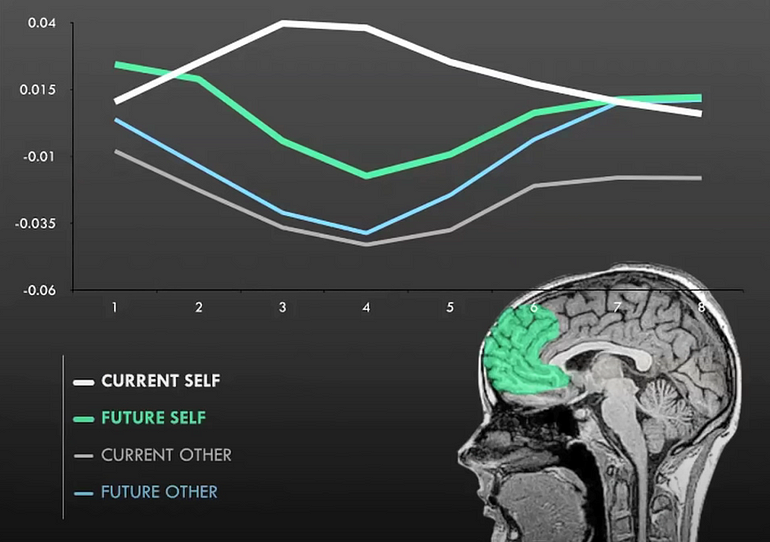
We think of ‘Future self’ as someone else! X-axis = time in seconds, Y-axis = % change in signal rate.
Our society also plays an oversized role in shaping our response to the climate crisis. Humans are herd animals. We like to band together in groups of like-minded individuals. Most members in these groups like to mimic other members of a higher social or economic standing (royal family, billionaires, celebrities, etc).
“Strong herd emotions helped prehistoric peoples summon the will and courage to take risks, to join such hunting parties (hunting Mammoths), and to collectively protect their families and villages” — Harvard Business Review, 2004
Private yards or lawns were originally a way for the British aristocracy to showcase their wealth and social status. Based on a 2005 study, lawns now occupy three times more area than the most irrigated crop in the US. Nothing useful grows on these lawns, except people’s egos! Despite the impact of land-use change on Earth’s climate, our desire to have the biggest front yards and back yards overpowers the need for preserving biodiversity.
Take Elon Musk for example — he is goofy, aloof, and brilliant, but more importantly, he owns a private jet, a yacht, and a few trillion-dollar companies! His tweets get more attention than IPCC reports on climate change. Most of the budding engineers want to be like him. But he also emits over 2000 tons of CO2 every year. We are not arguing that herd behavior is wrong; it is very normal, very human. We should extend our love for community, and our love for belongingness towards our planet.
“No one saves us but ourselves. No one can and no one may. We ourselves must walk the path” — Gautam Buddha
According to IEA, “Changes in behavior depend not only on individual choices, but also on systemic factors such as the availability of infrastructure such as bicycle lanes, public transportation or high-speed rail”. Yes, the government has a role in promoting and facilitating more climate-friendly behaviors among the masses, but the converse is also true. By signaling our intent towards sustainable living, we can force our government to reshape the policies for the benefit of our planet.
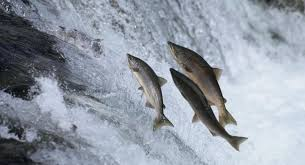
It is time to swim against the societal and biological currents. Image source unknown
We need to channel the inner Salmon inside all of us and swim against these currents that are preventing us from living sustainably. As Australian philosopher Roman Krznaric once said, “It’s time we all became good ancestors to our future generations.”
7 mins • 2026-06-02

5 mins • 2026-05-20

6 mins • 2026-04-18

6 mins • 2026-03-31

5 mins • 2026-01-23

5 mins • 2026-01-21
0
0
Copy Link
to write a comment.