Search for 'Coir Brushes'

3 mins
2024-10-03
0
0
Copy Link
We produce over 400 million tons of paper annually. Roughly 25 trees are required to produce one ton of paper. So, we need 10 billion (or 1000 crore) trees each year just to make paper; that’s more than one tree per person, per year. Shocking, right? All those cardboard boxes that get delivered to your doorstep, have their roots in a forest somewhere. Timber or wood is also heavily used in housing and construction. Trees help in absorbing (or sequestering) CO2 from the atmosphere, making them a crucial ally in the fight against climate change. So, is there a way to make paper, packaging materials and construction materials without damaging the planet and its climate? Enter bamboo.
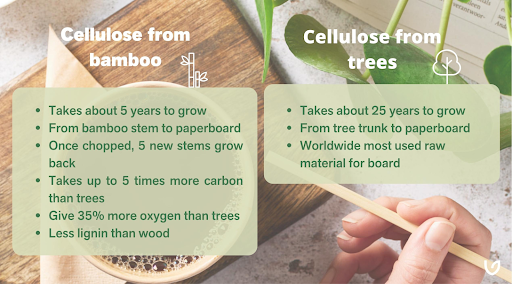
Cellulose is the main substance found in plant cell walls and is used to make clothes and paper. Source: Verive
Bamboo is a woody member of the grass family. It grows in many different climates and reaches maturity much faster than trees. Unlike trees that need to be replanted, harvesting bamboo can stimulate the growth of new bamboo shoots. Moreover, due to its rapid growth cycle, bamboo plants can absorb (or sequester) a lot more CO2 than most tree species, making them a great way to remove CO2 from the atmosphere. Based on a research study by Project Drawdown, a leading non-profit in the global climate action space, “Bamboo is already cultivated on 37 million hectares and represents an important high-carbon land use. It produces products of critical importance and can help reduce pressure on intact forests. It has been somewhat neglected as a mitigation strategy, and we hope to help bring this multipurpose mitigation solution the attention it deserves”.

Bamboo (on the right) sequesters carbon much faster than trees. Image source: Bamboo Nursery
The word bansuri (Hindi word for flute) originates from ‘bans’ [bamboo] + ‘sur’ [melody]. Every part of the bamboo plant has been used by humans for thousands of years. These uses can be classified into the following categories:
Check out this great video that talks about bamboo’s history, benefits and uses.
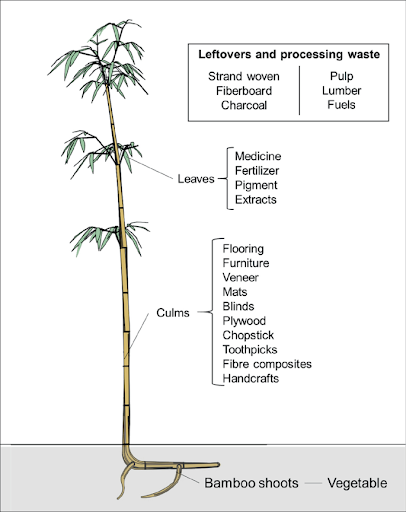
Image courtesy Maureen Harrison. Link here
According to the National Economic Forum (NEF), a leading not-for-profit, and independent think tank and policy research institution in India, “India, despite having the world's largest bamboo cover and being the second-largest bamboo producer with nearly 14.6 million MT of harvest in 2019, still imported 88% of its bamboo raw materials in 2021.” Why is that? The Indian Forest Act of 1927 classified Bamboo as a ‘tree’, which meant that bamboo grown in and around forested areas was out of bounds for villagers and inhabitants of these forests. Like many other colonial-era laws, this law had only one purpose - to increase profits for the British Raj. Thankfully, the tide is turning. As reported by Down to Earth in 2018, “After amending Section 2(7) of Indian Forest Act, 1927, bamboo is no longer a tree and felled bamboo too is not timber. So any bamboo grown in private or homestead land by millions of farmers does not require a felling permission or transit permission from any state forest department”. Being part of the Poacea or grass family, bamboo should have never been classified as a tree in the first place. This new ruling has started changing the landscape of the bamboo supply chain in India. Moreover, the government is now levying a 25% duty on imported bamboo to promote domestic production. Bamboo House India , a small construction company in Hyderabad, specialises in creating low-budget bamboo houses with bamboo sourced from Assam and other northeastern Indian states. Bamboo India and Bamboo Greens are making various household items out of bamboo. Mianzi is making beautiful cabinets and storage units using bamboo sourced within India. Some argue that bamboo is an invasive species, because of the sheer speed at which it grows and spreads. However, unlike most other invasive plants, bamboo does not spread through its seeds but through its roots. So, it is relatively easy to install a barrier to prevent bamboo from taking over the land. If bamboo is sourced from existing naturally occurring plantations, we do not have to worry about this.
As always, the best approach is to reduce paper usage. Enrol in paperless billing statements with your bank wherever possible. Reading e-books is another great way to reduce your paper footprint. Replace your conventional kitchen towel and toilet paper with those made from 100% recycled paper and/or bamboo fiber. Buy from zero-waste stores and carry your own bags when you go shopping, to minimise cardboard boxes that have become omnipresent due to e-commerce. Next time you are in the market for furniture, look for bamboo options on Google. Right now, bamboo products are more expensive than conventional products, however, with increasing consumer awareness and ramping up production, the prices for these items are bound to come down over time. So, if you are still bamboozled about how to go about living sustainably, maybe consider bamboo for your next purchase.
7 mins • 2026-06-02
5 mins • 2026-05-20

6 mins • 2026-04-18

6 mins • 2026-03-31
5 mins • 2026-01-23
5 mins • 2026-01-21
0
0
Copy Link
to write a comment.