Search for 'Coir Brushes'

4 mins
2024-09-19
0
0
Copy Link
There is one thing that unites all of us - we all want the best for our kids, and for our families. However, according to a research study spanning 25 countries, even though most of us want to live more sustainably, some barriers stand in the way of resolute climate action. Cost, lack of awareness, and lack of government/institutional support are often cited as the biggest hurdles. So, in today's article, we want to suggest five tips that can help you in your 'Ecoyaan', without making a hole in your pocket.
Many marketing campaigns have discussed the 3Rs - Reduce-Reuse-Recycle. However, refusing is a key aspect of sustainable living that we often overlook. Refusing plastic straws at a juice stall, refusing gifts on birthdays, and refusing 'free' or '1+1' offers for stuff we don't need are just a few examples. Next time you are offered chocolate, instead of change, say NO. We must push back against this idea of overconsumption, by saying no to unnecessary, unwanted things. America is the perfect example of how economic growth, fueled by overconsumption, can blind our society.
"Americanism: Using money you haven't earned, to buy things you don't need, to impress people you don't like" — Robert Quillen, June 1928

Say no to junk! Image courtesy saif71 on Unsplash
According to the National Institute of Health (NIH), "Individuals who spend more time in nature tend to be both healthier as well as more disposed toward acknowledging and addressing challenges to planetary health where nature can potentially offer solutions such as the slowing of the climate crisis". So, go take a walk in the park. Maybe find a lake or reservoir around your city where you can spend a weekend afternoon. Or take a short trip to a hill station near you. While you are admiring the beauty around you, take a few minutes and picture a world where these therapeutic places were lost to climate change. Now, remember that feeling when someone offers you murukku made with unsustainably sourced palm oil. Tribes living in the Indonesian rainforests are losing their natural habitat, along with thousands of animal species, for no fault of their own, to satisfy our snacking needs. You may be losing the natural habitat around you too (polluted rivers, melting glaciers, drying rivers), albeit a lot more gradually.
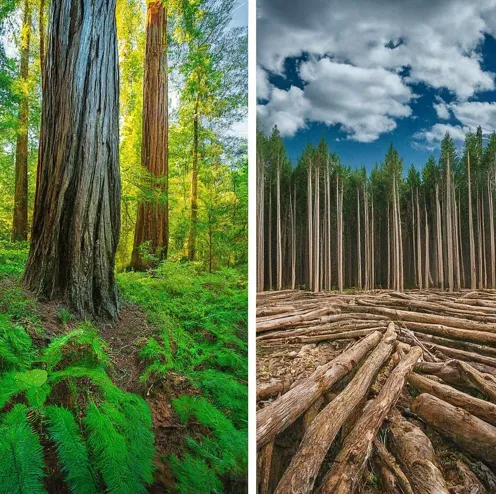
Which world would you rather leave behind for your kids?
Think about the source and destination of each item you consume on a daily basis. Everything in the living world works in a circular or cyclical manner, where nutrients are recycled to create new life. Unfortunately, humans have perfected the concept of linear living, built on the 'extract => produce => discard' mentality. In a world with finite resources, linear living is bound to collapse.
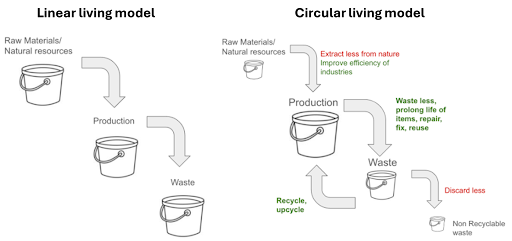
Illustrations created by the Author
The carbon footprint of producing one steel glass is more than that of producing a plastic glass. However, since most of the world's plastic does not get recycled, that plastic glass is inevitably going to end up in the ocean, choking marine life. On the other hand, that steel glass will typically last decades and get passed down through generations. Even if it is thrown in the dustbin, it is typically recycled to create a brand-new product.
Another great example is food waste. Today, one-third of the world's food is wasted. Rotting food produces methane, which can trap 80x more heat in the atmosphere, vs CO2. So, instead of buying excess food and discarding leftovers, purchase fewer things at a time and be ready to make more trips to the supermarket. Once you have minimized food wastage, you can also get rid of food scraps sustainably, by starting a home composting system. A compost pit, if done properly, does not produce any methane.
We are social creatures. Studies have shown that the health impact of loneliness is equivalent to smoking 15 cigarettes a day! So, when you are about to go on a mission to save our species (!!), it makes sense to involve other people in your quest. Here are some ways to get started:

Do not get trapped by 'Buy Now' or 'Buy with 1-click' options on your favourite e-commerce websites. Instead, spend at least 10 minutes looking up the ingredients, and the materials used to build the item you are interested in purchasing. See where the item was made, and how many km it travelled before reaching your doorstep. Try to find alternatives that are made using eco-friendly materials.

For example, sugarcane residue (known as bagasse) is now being used to create containers. You would never discover that if you opened the app and clicked on the first thing that popped up. Cosmetics is another industry going through an eco-transition, with more and more products being made using Ayurvedic principles. Did you know soapnut (or 'reetha'), is a great shampoo and soap alternative that you can make at home in a few minutes? You're welcome. As you eliminate chemicals from your life, you'll discover there are many things in our homes that serve no purpose (like hair conditioners, hair styling gels, and perfumes).
7 mins • 2026-06-02
5 mins • 2026-05-20

6 mins • 2026-04-18

6 mins • 2026-03-31

5 mins • 2026-01-23
5 mins • 2026-01-21
0
0
Copy Link
to write a comment.