Search for 'Coir Brushes'

4 mins
2024-08-29
0
0
Copy Link
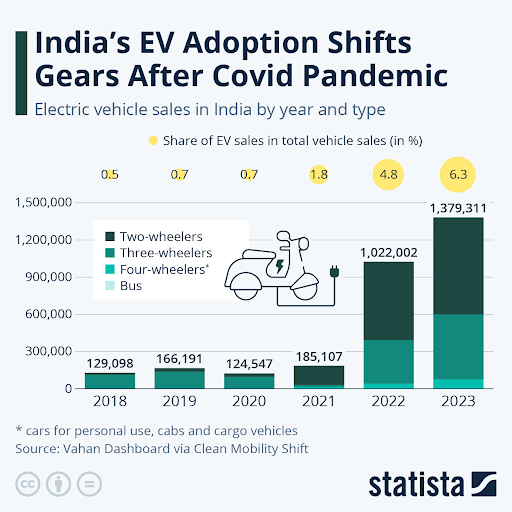
EVs or Electric vehicles are everywhere - lookout for the coveted green number plates next time you're on the road. According to the Federation of Automobile Dealers Associations (FADA), Indians bought over 1.67 million electric vehicles (EVs) in fiscal year (FY) 2024, which is a 42% increase from FY 2023. That includes all road vehicles, with 4-wheelers accounting for a small portion of EV sales. Currently, electric vehicles make up only 2% of all car sales in India, but the government is targeting that contribution to go up to 30% by 2030 [1]. Once considered too expensive for the Indian market, the cheapest electric car available today costs only 8 lac rupees. In comparison, the cheapest electric car in the United States costs thrice as much. So, it's all good news when it comes to EVs right? Well, not quite.
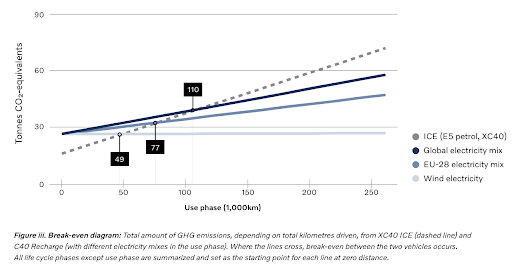
Firstly, there's the carbon emissions from producing and charging the battery itself. In 2021, Volvo published a fascinating report comparing the lifetime emissions of a petrol (or ICE) car and an electric car offered by them in the European market [2]. According to their calculations, even before you drive off the showroom, a large EV like the Volvo C40 has nearly twice the carbon footprint compared to a similar-sized petrol car. Moreover, their study shows that if the EV is charged using electricity generated from fossil fuels ('Global Electricity Mix'), it will take a really long time (1lac kms) for it to break even with a petrol car's emissions. Does that mean all EVs are bad? Definitely not.
Volvo's C40, used in the study above, has a large battery pack of ~70kWh. Tesla's new Cybertruck has a battery pack of 123kWh, which is not only absurd but also definitely NOT sustainable! Luckily, an average EV available in the Indian market has a much smaller battery pack (20-40kWh), which instantly lowers the production-related carbon emissions. Furthermore, if these vehicles can be charged using renewable sources of energy, our humble Indian EVs can start to look like a great choice from an environmental standpoint. For those who have the option, installing rooftop solar panels is a foolproof way of ensuring that your EV is charged using green energy.
Apart from the emissions from producing these batteries, there's also a big issue around mining and battery-related supply chains. Lithium-ion batteries, which power all electric vehicles today, are made up of metals like cobalt, lithium, nickel and graphite. Among them, cobalt is the most problematic. Most of the world's cobalt mines happen to be in sub-saharan African nations, particularly in the Democratic Republic of Congo (DRC). According to Siddharth Kara [3], the author of the book Cobalt Red, "People (in DRC) are working in subhuman, grinding, degrading conditions. They use pickaxes, shovels, stretches of rebar to hack and scrounge at the earth in trenches and pits and tunnels to gather cobalt and feed it up the formal supply chain." And it doesn't end there. Once cobalt is extracted, most of it ends up in China for further processing and eventually for the production of batteries. Kara says "They (China) have about 70, 80% of the refined cobalt market and probably half of the battery market". The overwhelming reliance on China is not good news for other countries hoping to transition to a green economy. The situation is bound to improve over time, as more countries discover mines with reserves of these precious metals and the supply chain becomes more diversified. But today, the batteries powering our lives and our drives, are leaving behind a trail of human rights violations.

A cobalt miner at the Shabara artisanal mine in Democratic Republic of Congo (DRC).
Image courtesy Junior Kannah/AFP via Getty Images
EVs are not the only option if you want to lower your ecological impact. Going back to Volvo's study, the petrol car assumed in their analysis is an XC40 which has a mileage rating of 13km/l. There are many petrol cars available with significantly higher fuel efficiency, upto 20km/l. Strong Hybrids (that have a small battery pack 2kWh) are also a good choice for the eco-conscious consumer, with some models [4] claiming upto 27km/l.
Don't forget, the most climate friendly thing to do is to drive less or to not drive at all. Taking public transport or buying a 2-wheeler is much more sustainable than any 4-wheeler. Driving conservatively, without accelerating and decelerating frequently is also a great way to get more juice out of your vehicles and to reduce your ecological impact. EVs are the future as major car manufacturers phase out R&D of petrol cars altogether. So, next time when you are considering an electric vehicle, try to get the smallest battery pack that works for your daily commute. Also, try to find out what percentage of your electricity comes from renewable sources. With that information at hand, you will be able to make a more informed choice
Here are some of the most popular EVs available in the Indian market today:
References:
ICE = Internal Combustion Engine
[1] https://www.reuters.com/business/autos-transportation/india-ev-sales-rise-66-this-year-after-nearly-doubling-2023-report-says-2024-04-05/
[2] https://www.volvocars.com/images/v/-/media/market-assets/intl/applications/dotcom/pdf/c40/volvo-c40-recharge-lca-report.pdf
[3] https://www.npr.org/sections/goatsandsoda/2023/02/01/1152893248/red-cobalt-congo-drc-mining-siddharth-kara
[4] https://www.hondacarindia.com/honda-city-ehev
7 mins • 2026-06-02
5 mins • 2026-05-20

6 mins • 2026-04-18

6 mins • 2026-03-31

5 mins • 2026-01-23

5 mins • 2026-01-21
0
0
Copy Link
to write a comment.