Global Warming vs Climate Change
By Sanjivani Pargal
4 mins
2025-04-14
0
0
Copy Link
Global Warming vs. Climate Change: What's the Real Difference?
Though the terms are used interchangeably, they are indeed different.
Global Warming: A Specific Phenomenon
Global warming specifically refers to the observed long-term increase in Earth's average surface temperature. This temperature rise is primarily driven by human activities that increase atmospheric concentrations of greenhouse gases such as carbon dioxide (CO₂), methane (CH₄), and nitrous oxide (N₂O). These gases enhance the natural greenhouse effect, trapping more heat in Earth's atmosphere.
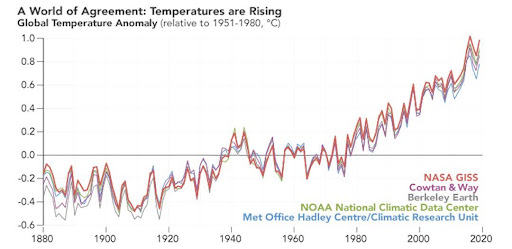
According to the Intergovernmental Panel on Climate Change (IPCC), the planet's average temperature has increased by approximately 1.1°C (2°F) since the pre-industrial era. The main contributor to this warming is the burning of fossil fuels, which releases significant amounts of greenhouse gases.
Climate Change: The Broader Consequences
Climate change encompasses a wider range of environmental transformations that result from the warming of our planet. While rising global temperatures are the primary driver, climate change manifests in various ways across Earth's systems, including:
- Altered precipitation patterns, with some regions experiencing increased rainfall and others facing more severe droughts
- Greater frequency and intensity of extreme weather events like hurricanes, typhoons, and heat waves
- Rising sea levels due to thermal expansion of oceans and melting glaciers, and ice sheets
- Changes in ocean currents and increasing ocean acidification
- Shifts in ecosystems and biodiversity, affecting plant and animal habitats
As Barack Obama noted: "Climate change is no longer some far-off problem; it is happening here, it is happening now."
The Relationship: Cause and Effect
To clarify the relationship between these terms, global warming is the primary cause, while climate change encompasses the broader set of effects.
Think of it this way: Global warming is the specific process of increasing global temperatures, while climate change refers to the full range of environmental changes triggered by this warming. Global warming is the underlying mechanism, while climate change represents the diverse consequences we observe throughout Earth's systems.
Why This Distinction Matters
Understanding the difference between these terms is important for several reasons:
- Clear Communication : It allows for more precise discussions about specific aspects of our environmental challenges.
- Targeted Solutions : Different aspects of climate change require different approaches. Reducing greenhouse gas emissions addresses the root cause (global warming), while adaptation strategies help communities cope with the various effects of climate change.
- Comprehensive Understanding : Recognizing the cause-and-effect relationship helps illustrate how a single phenomenon (rising temperatures) can trigger numerous complex changes across our planet.
Conclusion
Global warming and climate change are not interchangeable terms. Global warming refers specifically to the increase in Earth's average temperature, while climate change encompasses the broader set of environmental transformations that result from this warming.
By understanding this cause-and-effect relationship, we can better comprehend both the urgency and complexity of our environmental challenges. Addressing global warming through reduced greenhouse gas emissions remains our most critical strategy for limiting the cascading effects of climate change across our planet.
Related posts
7 mins • 2026-06-02
Climate Change in 2026: What the Data Says, What It Means for India, and What You Can Do
5 mins • 2026-05-20
Filling Up on the Future: What Biofuels Mean for India

6 mins • 2026-04-18
Sustainable Travel Tips: How to Explore the World Without Trashing It

6 mins • 2026-03-31
What Makes Women Stronger: 10 Everyday Swaps for a Better Body and Planet

5 mins • 2026-01-23
The Zero-Waste Bathroom: 5 Easy Swaps to Cut Plastic & Waste

5 mins • 2026-01-21
Top 12 Eco-Friendly Habits to Build in 2026
What do you think?
0
0
Copy Link
to write a comment.