Search for 'Coir Brushes'


6 mins
2024-10-26
0
0
Copy Link
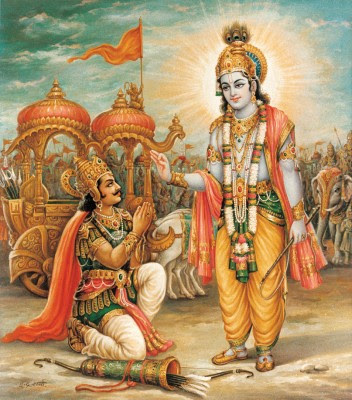
Lord Krishna and Arjuna, just before the Kurukshetra war. The setting of the Gita. Source: Twitter/X
I have always been a person of ‘science’, not believing in anything supernatural or anything to do with religion. However, I decided to read a version of the Bhagavad Gita (meant for young kids!) to understand why our society reveres this chapter of the epic Mahabharata. Whether you are a religious person or not, the Gita can teach us a lot about how to lead a good life, and how to be responsible citizens. I have come to realise that this millennia-old text can also help us repair the broken bonds between humanity and the natural world around us.
Towards the end of the Gita, Krishna lays down some ground rules for being a good, virtuous person. Surprisingly, worshipping god is not part of that list. Of course, devotion to a higher power is cited as a good way to follow these rules, but as per the Gita, worship is not a prerequisite. This is why Gita has transcended religion and influenced so many people worldwide, regardless of their faith and their background.
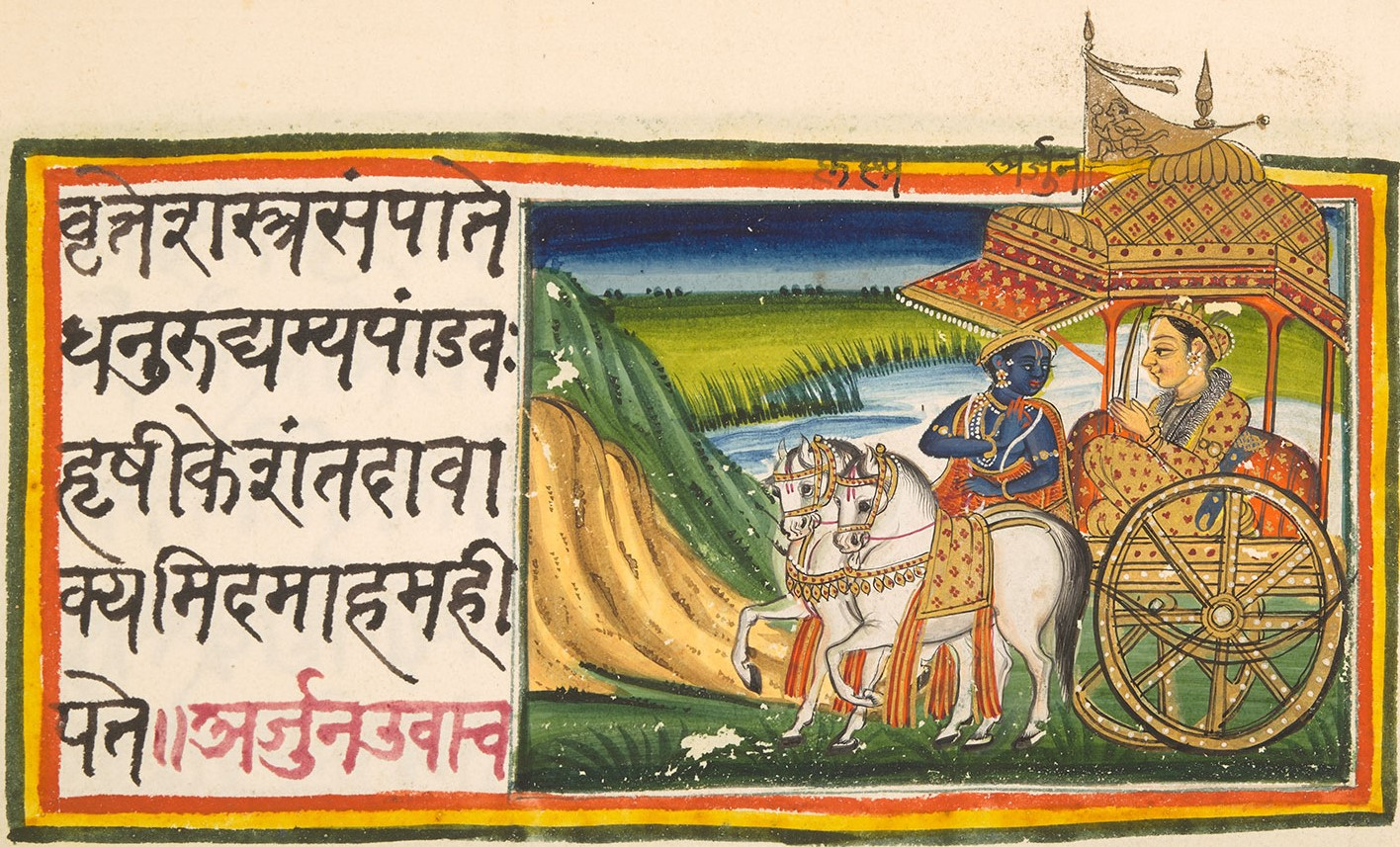
Source: Wikipedia
Before we get into the main learnings from this holy book, it is important to understand the context. Bhagavad Gita is a conversation between Lord Krishna and the mighty archer, Arjuna. It happens right before the start of the great Kurukshetra War between the Pandavas and the Kauravas.
Just before entering the battlefield, Arjuna starts having second thoughts about fighting against his extended family (aka Kauravas). He is in a mighty catch-22 -- if he fights, he will be forced to kill his cousins and uncles. But if he runs away, he will always be regarded as a coward who chickened out on the battlefield. At this crucial juncture, Arjuna decides to resolve this inner storm by asking his good friend Krishna for advice.
Many of us face such difficult decisions in our busy lives - whether to focus on wealth or family. Whether to prioritize the environment or convenience. Whether to spend time on leisurely activity or purpose-driven hobbies. Eknath Easwaran, the famous Indian writer who wrote a popular translation of the Bhagavad Gita, writes, ‘Arjuna's dilemma is acutely modern, and the Gita's message remains as relevant for us now as it was for ancient India.’

Choosing the right path can be hard. That’s what the Gita is about. Image source link
If there is one teaching or message that reverberates throughout this holy text, it is that of Karma Yoga. Lord Krishna tries to convince Arjuna that ‘Karma-phala-tyaga’ (or renunciation of the fruits of actions) is the key if someone wants to lead a virtuous and meaningful life. He is trying to convince him that running away from the battlefield may be possible for Arjuna’s physical body, but his soul and mind will always be plagued by thoughts of abandoning his side in battle. Krishna reiterates to Arjuna that action is superior to inaction, regardless of the outcome of your actions. Karma Yoga is all about performing our duties with selflessness and devotion. Of course, this is easier said than done, particularly in a society that teaches us to be number one at everything - school, college, and then the workplace. But we must try.
“Action leads to knowledge, while selfless action leads to spiritual awareness” - Bhagavad Gita, chapter 4
The action of protecting the planet from dangerous greenhouse gases is our collective duty, despite how daunting it seems for an individual to have any meaningful impact. If we get bogged down by the difficulty level of this endeavour, we will naturally gravitate towards laziness and inaction. And according to the Gita, inaction is the biggest sin. After denying human-induced climate change, many people now argue that individual action will do very little to stop the climate catastrophes that lie ahead. It is fascinating to see the similarities in our response to climate change and COVID-19, as shown in the table above.

Source: https://skepticalscience.com/print.php?n=4727
“If you only enjoy the gifts of the Universe, the life-giving sun, the nourishing rain, the fertile earth, the lofty mountains, the flowing rivers - and not put your own shoulder to the wheel, offering your effort back to the Universe, you are no better than a common thief,” said Lord Krishna. This quote can be found in The Gita For Children, by Roopa Pai.
“In the beginning of creation, a relationship was created between humanity and nature. If that relationship is respected, nature bestows upon humanity everything desirable for a happy life and liberation.” - said Lord Krishna. This quote can be found in Stories To Remember , A New York Cultural Organization.
Even though I chose to summarise the environmental learnings from the Bhagavad Gita in this article, I could have very easily picked the Quran or the Bible for this purpose.
“Islam teaches its followers to take care of the earth. Muslims believe that humans should act as guardians, or Khalifah, of the planet, and that they will be held accountable by God for their actions.” - Ibrahim Ozdemir, a renowned environmentalist and professor of philosophy at Uskudar University, Turkey.
Six out of seven people in the world are believed to be religious. Protecting the earth is a common theme in most holy scriptures around the world. Greed is considered a sin by all major religions. However, we are destroying our planet at an unprecedented rate, to satisfy our greed for money and societal power. If you worship a higher power, it may be time for some inner reflection. It is time we start being stewards of the Earth, not because of climate change, but because it is the right thing to do.

7 mins • 2026-06-02

5 mins • 2026-05-20

6 mins • 2026-04-18

6 mins • 2026-03-31

5 mins • 2026-01-23

5 mins • 2026-01-21
0
0
Copy Link
to write a comment.